Introduction
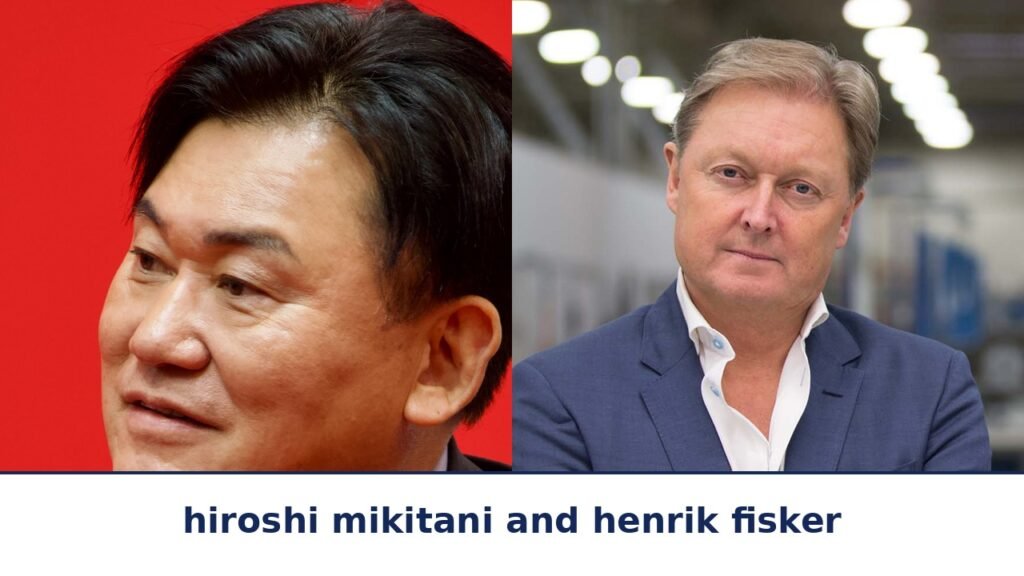
hiroshi mikitani and henrik fisker is a name pairing that joins two founders whose careers took shape on opposite sides of the world, one in the internet economy of Japan and the other in the design studios of the car industry, and the first question most readers ask is what could possibly join them. One is a Japanese banker turned entrepreneur who built one of the largest online retail groups in Asia from a tiny marketplace with a handful of staff, while the other is a Danish car designer who shaped some of the most admired luxury cars of his generation and then tried twice to build a car company under his own name. Their worlds rarely touch, since one sells through screens and the other shapes steel, yet both men reached the top of their fields through the same stubborn habit of starting over when the first plan failed.
This guide gives both men a full and fair account, using only facts that can be checked in public sources, and it answers the connection question honestly at the end rather than inventing a shared history. Readers who want a hiroshi mikitani biography will find the story of a Kobe-born banker who left a safe career after an earthquake shook his home city and decided to rebuild part of the Japanese economy online, and readers who want a henrik fisker biography will find the story of a Danish schoolboy who sketched cars in notebooks, studied design in Switzerland, and went on to draw the BMW Z8 and the Aston Martin DB9. Readers who follow business leader profiles will recognise both stories as classic founder stories, built on long patience, bold risk, and a willingness to carry a famous name into public failure and try again.
The sections that follow work in order, starting with Mikitani, then Fisker, then a side-by-side look at their careers, and finally the connection question itself. Where a figure moves with markets, this guide says so plainly, because a pairing that starts with curiosity deserves an honest answer rather than a polished myth.
Contents
hiroshi mikitani and henrik fisker: The Kobe Banker Who Built an Internet Empire
Hiroshi Mikitani was born on March 11, 1965, in Kobe, Hyogo Prefecture, Japan, into a family where learning and public service set the tone of daily life. His father, Ryoichi Mikitani, was an economist and a professor at Kobe University who had been Japan’s first Fulbright Scholar to the United States, and his mother Setsuko, also a Kobe University graduate, had worked for a trading company and spent part of her childhood in New York. The family lived in New Haven, Connecticut, from 1972 to 1974, while his father taught at Yale University, so the young Mikitani saw American life early, an experience that later shaped his comfort with global business. His grandfather had been a businessman active in New York and a co-founder of Minolta, the camera maker, while his sister Ikuko became a physician and his brother Kenichi a professor of biology at the University of Tokyo.
Mikitani attended Hitotsubashi University in Tokyo, graduating in 1988 with a degree in commerce, and then joined the Industrial Bank of Japan, one of the country’s most respected banks, where he worked as an investment banker. In 1991 he left the bank for two years to study at Harvard Business School in Cambridge, Massachusetts, earning his MBA in 1993, and then returned to banking with a wider view of how American and Japanese business worked. The hiroshi mikitani rakuten story begins with a break from that safe path, since he left the bank in 1995 and founded his own consulting firm, Crimson Group, a small outfit that gave him his first taste of running a company under his own name. The decision looked risky at the time, since lifetime employment at a major bank was still the expected road for a graduate of his standing, yet Mikitani had already decided that he wanted to build rather than advise.
The event that pushed him from consulting into founding a lasting company was the Great Hanshin Earthquake of January 1995, which devastated Kobe, his home city, and killed thousands of people while wrecking homes, roads, and businesses across the region. Mikitani later said that the destruction made him want to help rebuild the Japanese economy, and he saw the young internet as the tool that could give small merchants a fresh start without the heavy costs of a physical shop. In February 1997 he founded MDM, Inc., with a small team and a modest sum of his own savings, and on May 1, 1997, the company launched Rakuten Ichiba, an online shopping mall where small shops could open their own storefronts and reach customers across Japan. The name Rakuten means optimism in Japanese, and the early mall started with only thirteen shops and six staff, a tiny beginning for a company that would one day serve members across the world.
hiroshi mikitani and henrik fisker: From a Small Marketplace to a Global Group
The hiroshi mikitani founder story is a story of steady expansion rather than a single sudden breakthrough, since Rakuten grew by adding one service after another around its core marketplace. The company changed its name to Rakuten, Inc., in 1999 and listed on the Japanese stock market in 2000, giving it the capital to widen its reach, and over the following years it added travel booking, banking, credit cards, e-books, and mobile phone services to its range. Mikitani led this growth with a clear method, keeping prices low for merchants, giving shops control over their own pages, and building loyalty through a shared points system that tied the different services into one ecosystem. By the late 2010s the group counted tens of thousands of shops on its platforms and more than one hundred million members in Japan alone, and its annual sales ran into billions of dollars, a scale that few online firms outside the United States and China had reached.
From 2010 onward Mikitani pushed Rakuten past Japan, buying online retailers and services abroad, including Buy.com in the United States, PriceMinister in France, and the Canadian e-book service Kobo, while also taking stakes in firms such as Pinterest and the ride-hailing company Lyft. To make a global company work, he launched an Englishnization drive in 2010, making English the official internal language of the company within two years, a move that drew wide attention in Japan and forced thousands of staff to raise their English skills. The same period brought him wider public roles, since he became chairman of the football club Vissel Kobe, chairman of the Tokyo Philharmonic Orchestra, and a board member of Lyft, while also co-founding the Japan Association of New Economy, a business group that argues for open internet rules. In 2014 the French government named him a Knight of the Legion of Honour for his contributions to the economy and culture of France, and in 2012 Harvard Business School gave him its Alumni Achievement Award, one of the school’s highest honours.
Rakuten’s later years show the harder side of building a large group, since the company launched its own mobile network in Japan, a costly project that weighed on profits for years, and its share price and fortune figures moved sharply with those results. Forbes-based reports put Mikitani’s net worth near seven billion dollars in 2017, while later reports showed lower figures as the mobile business drained cash. Readers should treat any single fortune figure as a dated snapshot rather than a fixed fact, since it moves with share prices and with the value of private holdings that are hard to price exactly. Through these swings Mikitani has stayed in charge as founder, chairman, and chief executive, still based in Tokyo with his wife Haruko, whom he married in 1993, and their two children.
hiroshi mikitani and henrik fisker: The Danish Designer Behind Two Icons
Henrik Fisker was born on August 10, 1963, in Allerod, Denmark, a small town north of Copenhagen, and his love of cars began in childhood when he saw a Maserati Bora on the highway and started sketching car designs in school notebooks. He studied transportation design at the Art Center College of Design in Vevey, Switzerland, graduating in 1989, a school known for training designers for the world’s car makers, and his first job took him to BMW in Munich, where he worked at the firm’s advanced design studio. His early work at BMW included the E1 electric concept car, a small city car that drew little attention at its debut, yet it gave him his first lesson in electric driving years before electric cars found a mass market. The henrik fisker bmw z8 chapter came next, since he designed the Z07 concept car, shown at the 1997 Tokyo Motor Show, which became the BMW Z8 roadster, a retro-styled sports car with a powerful V8 engine that later appeared in a James Bond film and became a collector favourite.
After BMW, Fisker moved into senior design leadership, serving as president and chief executive of DesignworksUSA, BMW’s California-based design consultancy, from 2000, and then joining Ford in 2001 as design director for Aston Martin, the British luxury car maker that Ford then owned. At Aston Martin he led the design of the DB9, a grand tourer that arrived in 2004 and became one of the brand’s most important models, along with the V8 Vantage, a smaller sports car that widened Aston’s appeal to new buyers. Both cars carried his signature mix of clean lines, long bonnets, and muscular rear haunches, and the DB9 in particular set the visual language that Aston Martin followed for more than a decade. Fisker also led Ford’s global advanced design studio in California and its Ingeni creativity centre in London.
In 2005 Fisker left large car makers to start his own firm, Fisker Coachbuild, based in Southern California, with his business partner Bernhard Koehler, building low-volume luxury cars on existing platforms, including the Tramonto, based on a Mercedes roadster, and the Latigo, based on a BMW coupe. Only a small number of these hand-built cars reached customers, yet in 2007 he and Koehler founded Fisker Automotive with the goal of building a luxury plug-in hybrid car that could match traditional luxury cars for style while using far less fuel. The result was the Fisker Karma, a striking four-door sports sedan with solar panels in its roof, which debuted at the 2008 North American International Auto Show in Detroit and won design awards, including a place among Time magazine’s fifty best inventions of 2011. The Karma was the world’s first premium plug-in hybrid, and its looks drew praise from critics who had doubted that an environmentally friendly car could also look desirable.
hiroshi mikitani and henrik fisker: Two Companies, Two Collapses, One Ocean
The henrik fisker fisker inc story cannot be told without the collapse that came first, since Fisker Automotive struggled with production delays, supplier troubles, and reliability problems even as its car won praise for design. The company received a large federal loan from the United States Department of Energy, yet it missed production targets, and its battery supplier, A123 Systems, went bankrupt, cutting off a key part of the car. Production stopped in November 2012, Fisker resigned as chairman in March 2013 after disagreements with management over strategy, and the company filed for bankruptcy later that year, with its assets later bought by China’s Wanxiang Group, which revived the Karma under the Karma Automotive name. Fisker also faced a lawsuit from Tesla in 2008, which claimed he had misused design work from a brief contract, a case Tesla later dropped, yet the episode showed how fierce the early electric car race had become.
Undaunted, Fisker founded a second company, Fisker Inc., in 2016 with his wife Geeta Gupta-Fisker, built around an asset-light model that avoided owning a factory, since he argued that the factory itself had been the problem the first time. The new firm’s first model was the Fisker Ocean, a five-seat electric SUV with recycled materials, a solar roof option on higher trims, and an advertised range of up to 360 miles for the Ocean Extreme version, as rated by the United States Environmental Protection Agency in June 2023. Fisker Inc. went public in 2020 through a merger with a listed acquisition company, and at one point its market value rose past eight billion dollars, while production was outsourced to Magna Steyr in Graz, Austria, which began building the Ocean in November 2022. The Ocean reached customers in 2023, yet software faults, loss-of-power incidents, recalls, and safety investigations followed, and cash ran short as production paused in early 2024.
In June 2024 Fisker Inc. filed for Chapter 11 bankruptcy protection in the United States, with similar protection sought in Austria, and production of the Ocean stopped for good, leaving owners with cars whose maker could no longer support them in the usual way. Magna later ended its manufacturing agreement for the Ocean, while unsold Ocean cars were sold at steep discounts through fleet buyers and dealers. For Fisker the result repeated the pattern of his first venture, since both companies carried his name into bankruptcy, a record that makes him one of the most discussed figures in the electric car industry, admired for design talent and criticised for business execution in equal measure. He remains based in Los Angeles, California, and his design catalogue still includes the BMW Z8, the Aston Martin DB9 and V8 Vantage, the Fisker Karma, the Galpin-Fisker Mustang Rocket, the VLF Force 1, and the Fisker Ocean, a body of work that few living designers can match for range.
hiroshi mikitani and henrik fisker Facts at a Glance
| Point | Hiroshi Mikitani | Henrik Fisker |
|---|---|---|
| Born | March 11, 1965, Kobe, Japan | August 10, 1963, Allerod, Denmark |
| Education | Hitotsubashi University, commerce, 1988; MBA, Harvard Business School, 1993 | Art Center College of Design, Vevey, Switzerland, transportation design, 1989 |
| Defining role | Founder, chairman and chief executive, Rakuten, since 1997 | Founder of Fisker Automotive (2007) and Fisker Inc. (2016) |
| Signature work | Rakuten Ichiba marketplace; Rakuten ecosystem of more than 70 services | BMW Z8; Aston Martin DB9 and V8 Vantage; Fisker Karma; Fisker Ocean |
| Major setback | Costly mobile network launch that weighed on group profits for years | Two car companies under his name filed for bankruptcy, in 2013 and 2024 |
| Honours | Knight of the Legion of Honour, France, 2014; Harvard Alumni Achievement Award, 2012 | Time fifty best inventions, 2011, for the Fisker Karma; design awards for the Karma and Ocean |
| Family | Married Haruko Mikitani in 1993; two children | Married Geeta Gupta-Fisker in 2012; two children |
| Fortune snapshot | Near seven billion dollars, Forbes-based, 2017; lower in later reports as markets moved | No settled audited fortune figure; wealth tied to company stakes that lost value in bankruptcy |
| Verified link to the other person | None found in the public record | None found in the public record |
The table above gathers the core of hiroshi mikitani and henrik fisker into one place, and its most useful row may be the last one, since it stops a reader from assuming a partnership that the record does not support. Mikitani’s fortune rests on an internet ecosystem built over three decades in Japan, while Fisker’s standing rests on design talent shown across German, British, and American car makers, and the two kinds of success rarely meet in the same room. A reader who keeps that distinction in mind will read the pairing as a study in contrast rather than as a hidden alliance, which is the honest way to read it.
hiroshi mikitani and henrik fisker: Is There a Verified Connection?
The direct answer is no, because no verified record shows a shared deal, a shared company, a shared board, an endorsement, or a documented meeting linking hiroshi mikitani and henrik fisker, and readers should treat any page that claims such a link without naming a source as speculation rather than fact. Mikitani’s world is Japanese e-commerce, fintech, mobile networks, football, and orchestras, while Fisker’s world is German design studios, British luxury car makers, California start-ups, and Austrian factories, and their paths run through different countries, industries, and institutions. No company filing, deal announcement, or reputable news report found during research for this guide places their names side by side in any working capacity, and the hiroshi mikitani and henrik fisker connection question therefore has the same honest answer as many paired name searches, which is that the pairing reflects reader curiosity and the habit of biography sites to group prominent founders, not a hidden partnership.
It is worth naming what was found instead of a connection, since the contrast itself explains why readers search for the two names as a pair. Both men founded companies that carry their own names, both expanded from a single product into a wider range of services or models, both faced a major financial crisis that tested their leadership, and both appear on lists of notable founders in their fields. Readers who follow entrepreneur profiles will see the same founder pattern in both stories, yet none of those parallels amounts to a link, and this guide records them as parallels only.
Conclusion
hiroshi mikitani and henrik fisker brings together a Japanese internet founder who turned a tiny online mall into a global services group and a Danish car designer who drew two modern icons and then twice carried his own car company into bankruptcy, two careers built on bold risk and long patience but with no verified personal or professional link joining them. Readers who remember that distinction will take away the real value of the pairing, which is a clearer picture of two remarkable founders rather than a partnership that never existed.